About WJSCL
Our History
From open prairie to one of Edmonton's most connected west-end communities, the story of West Jasper Place and Sherwood spans more than seven decades.
From Prairie to Community

The land that is now West Jasper Place and Sherwood was open prairie in the early 1900s, subdivided around 1910 as part of the broader Jasper Place area west of Edmonton. Settlers came for cheap land and low taxes, and through the interwar years a loose community of small farms and homesteads slowly took shape.
Everything accelerated after the war. The 1947 Leduc oil discovery brought thousands of workers and their families to the Edmonton region, and Jasper Place absorbed much of that growth. By 1948 it had 4,000 residents and was the largest hamlet in Alberta. It incorporated as a village in 1950, was reclassified as a town almost immediately, and by 1954 had swelled past 13,600 people. At its peak, the Town of Jasper Place held the remarkable distinction of being the largest town in Canada, with over 37,000 residents by 1964.
A town that size needed city-scale infrastructure. On August 17, 1964, the Town of Jasper Place amalgamated with the City of Edmonton. The municipal boundary disappeared, but the neighbourhoods it contained, including West Jasper Place and Sherwood, kept their identities.

Two Leagues, One Community
Community leagues were part of the post-war building boom. The Sherwood Community League was established in 1949, and the West Jasper Place Community League followed in 1950. Both shared the same east and west boundaries—149 and 156 Street—but sat one above the other: Sherwood between 92 and 95 Avenue, West Jasper Place between 95 Avenue and Stony Plain Road. Both were volunteer-run from day one, organizing sports, running events, and advocating for the services that young, growing neighbourhoods needed.
For over three decades, the two leagues operated independently. By the mid-1980s the neighbourhoods shared many of the same families, the same facilities, and the same priorities. In 1985 they formally merged to create the West Jasper Sherwood Community League (WJSCL), combining their resources into a single organization that better reflected how residents actually lived.
The league is part of the Edmonton Federation of Community Leagues (EFCL), a century-old network of over 160 volunteer-run leagues across the city, the largest system of its kind in North America.

The Newman's Resolution
In 1980, Alderman Ken Newman put forward a motion to Edmonton City Council: the residential core of West Jasper Place, between 95 Avenue and 100 Avenue, from 149 Street to 156 Street, would remain zoned for single-detached housing. Council passed it, and for 35 years the Newman's Resolution held, an unusual instrument in Edmonton planning that preserved the neighbourhood's interior character while development pressures reshaped much of the surrounding area.
During that time, the neighbourhood continued to grow on its own terms. Between 2002 and 2012 alone, 45 new single-detached houses were built within the protected area.
In 2015, council replaced the resolution with the Jasper Place Area Redevelopment Plan (ARP), developed through three years of community workshops and public consultation. The ARP took a more nuanced approach: protecting the character of interior residential streets while enabling greater density and mixed-use development along corridors like Stony Plain Road and 149 Street. The principles behind the original resolution, thoughtful development, respect for what exists, and genuine community input, carried through.
The Neighbourhoods Today
West Jasper Place and Sherwood were joined under one league in 1985, but they remain two neighbourhoods with different street patterns and landmarks.
West Jasper Place stretches north of 95 Avenue to Stony Plain Road; Sherwood lies to the south, quieter and made up mostly of single-detached housing. Residents move between them for schools, programs, and day-to-day errands, and the league boundary still takes in both.
West Jasper Place

West Jasper Place is a postwar neighbourhood built on a classic grid of generous 50-by-150-foot lots, originally filled with modest bungalows and split-levels, now increasingly mixed with modern infill homes. Mature American elms line the boulevards, their canopies forming green tunnels that are among the best streetscapes in west Edmonton. Along 100 Avenue, a multi-use trail winds through Hansa rose bushes and mature trees, connecting within a block to the McKinnon Ravine trail system and its views of the North Saskatchewan River valley.
Arthur Elliott Park at 9620 152 Street sits at the heart of the community, home to the WJSCL Community Hall. Sherwood Elementary School is steps away at 9550 152 Street. Jasper Gates Mall anchors the northeast corner with FreshCo and London Drugs, and the former Grant MacEwan Faculty of Arts building at 10045 156 Street was redeveloped as the City of Edmonton Orange Hub, a multicultural arts and culture facility.
In 2013, the neighbourhood received a comprehensive infrastructure upgrade: new street lights, roads, sidewalks, and sewers throughout the residential area. Two years later, Stony Plain Road between 149 and 158 Street was rebuilt with new infrastructure and streetscaping.
Sherwood
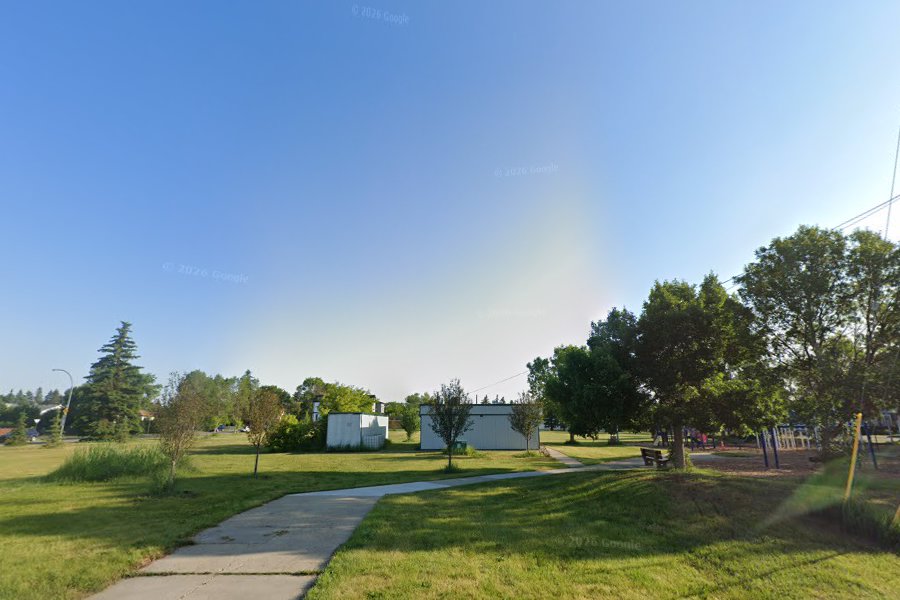
South of 95 Avenue, Sherwood is a quieter, primarily residential neighbourhood. Most of the area is single-detached housing, with apartment zoning concentrated along 149 Street and some multi-family on 156 Street. Sherwood Community Park at 15430 93 Avenue is the main green space. Residents are close to the Jasper Place Public Library at 9010 156 Street and Meadowlark Shopping Centre along the southern edge.
The Community Hall

The WJSCL Community Hall at 9620 152 Street NW is the league's home base. It features a commercial kitchen, a stage with a full sound system, and air conditioning. The hall hosts league programs year-round and is available for private rentals.
Next to the hall, Arthur Elliott Park provides green space. In winter, the league maintains an outdoor ice rink; in warmer months, tennis courts are open for use.
Programs and Activities
Sports & Fitness
Brazilian Jiu-Jitsu, community soccer, hockey
Social
Weekly board game nights, progressive rummy, carpet bowling
Family & Youth
Kids' craft nights, Super Smash Bros tournaments, movie matinees
Community Swim
Free access to Jasper Place Leisure Centre during designated weekend hours for members
What's Ahead

The most significant change on the horizon is the Valley Line West LRT, a light rail extension that will run along Stony Plain Road at the neighbourhood's northern edge. A stop at 156 Street will sit right at the league's western boundary, giving residents a direct, car-free connection between the west end and downtown.
West Jasper Place and Sherwood were built by families who saw promise in the west end. That hasn't changed. What has changed is the neighbourhood's position: no longer at the edge of the city, but increasingly one of its most connected and livable communities.
The West Jasper Sherwood Community League acknowledges that our neighbourhoods are located on Treaty 6 territory, the traditional and ancestral lands of the Cree, Dene, Blackfoot, Saulteaux, Nakota Sioux, and Métis peoples. We honour the enduring relationships between Indigenous peoples and this land, and we are committed to building a community that reflects the values of respect, inclusion, and reconciliation.
Find Us
The WJSCL serves West Jasper Place and Sherwood, bounded by Stony Plain Road to the north, 149 Street to the east, 92 Avenue to the south, and 156 Street to the west.
Open in Google MapsWest Jasper Place
Sherwood
Be Part of the Story
Whether you've lived here for decades or just moved in, the league is your connection to the community.